APUSH can be beast for students and teachers, but it does not need to be. I work with many Advanced Placement United States History, commonly called APUSH, in my tutoring practice. The number of factual details that some teachers encourage students to commit to short term memory overwhelms many students. Teachers can also feel pressure to cover vast amounts of material. Like students, many teachers imagine that the quantity of material covered is what makes an AP class rigorous. I am gathering and revising my tutoring materials this week in preparation for the new school year, and I have added new wrinkle to my approach to helping students navigate this class.

Of course, advanced history students do need to master some factual knowledge to use as evidence to support claims. I am always telling students that they do not need to know everything, but they do need to know somethings. It’s a tricky balance with teenagers.
One way that I manage this is by focusing on the key concepts in APUSH. There are twenty five key concepts in the course and exam description. The current CED is organized around nine units, most with more than ten learning objectives, 105 in total. The original key concepts remain embedded in this stack of objectives, and teachers, students, and tutors can pull them out for focus to help to organize the information. The words in the key concepts are the most important in the course.
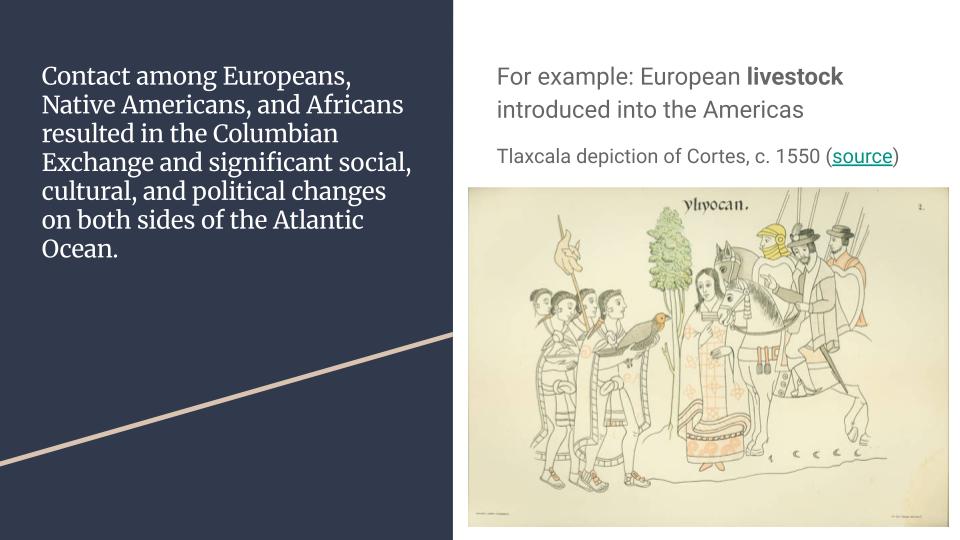
The slide pictured above features Key Concept 1.2 (1491 – 1607 CE). It allows students to focus—Columbian Exchange is one of the highest priority terms in unit—and to categorize related information into social, cultural, and politic effects. I use the key concepts in all three AP History classes (US, World, and European) since I started tutoring six years ago. From these basic understandings students can connect the facts that they do know—from prior classes, reading, or class materials—to key concepts.
My wrinkle for the coming school is to be more direct in showing students how examples work as evidence in history classes. I am creating a slide like the one above for each of the twenty-five key concepts in APUSH. In conversations with students over the past few years I realized that distinguishing between claims and evidence is difficult for many more students than I suspected. My hunch is that this is a result of the torrent of information than my students experience, but I’m not sure. Either way encouraging them to curate examples that can be used as evidence to support claims is crucial to their success on the AP Exam. Guided practice is the essence of learning. Showing students an example of a concept, such as the diffusion of horses to the Americas in the example above, is a way to introduce them to producing their own examples, which is the goal.
The AP History courses provide another tool for helping students to do more with fewer examples: historical thinking skills. Historical Thinking Skill 5: Connections. This element directs students to analyze comparison, causation, and patterns of continuity and change. Students should get into the habit of checking similarities/differences, causes/effects, and continuities/changes with each example. Most history classes emphasize these skills, but it is often downstream from all of the information. I focus on this type of analysis as students and I work through examples initially with a goal of students thinking more carefully about fewer examples as they study. The historical connections naturally multiple knowledge as students can link new information with existing knowledge.
The key intervention is helping students to see that they do not need to master all of the examples. In fact knowing many examples and how to use them is much better than knowing many more examples but superficially. APUSH, like all history classes, sometimes gets a bad name is a site for drill-and-kill instruction. But, it doesn’t need to be that way. Students can learn to curate and to think in history classses.
Caveats: It’s neither all APUSH classes or just APUSH classes. The students working with a tutor are more likely than others to be in a class that is frustrating. It’s not just APUSH; students in non-AP US History classes can feel similarly overwhelmed by the amount of material. In fact, I used the image above to break the ice with a such a student. He laughed out loud. And, students in any class, including other history classes can feel the same. Teachers should always value wisdom along with knowledge. All of us need to resist the temptation to replace intellect rigor with quanity of information.
NB: My love of the em dash is entirely natural. No LLMs were used in the production of this post.
